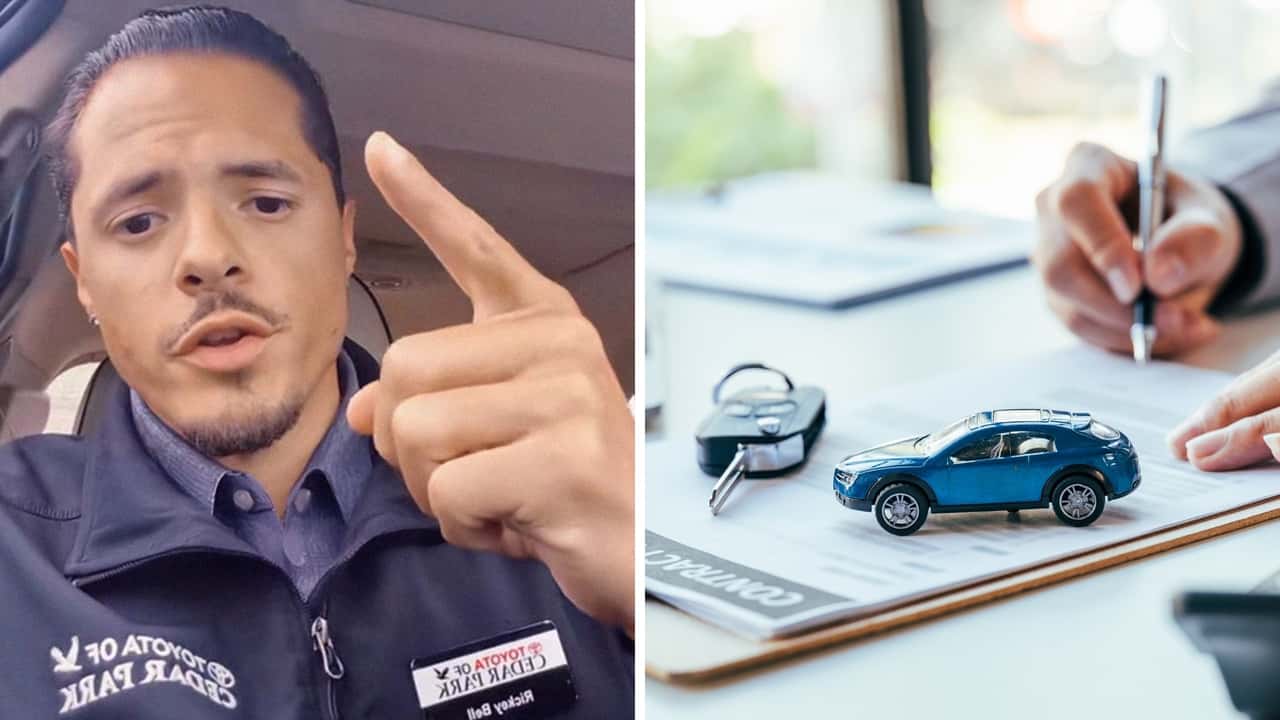
‘The best way to get out of a car that you’re stuck in.’
A Texas Toyota salesman has been promoting a strategy on TikTok for car owners who are stuck owing more on their vehicle than it’s worth. He says that instead of trading it in and rolling that negative equity into another loan, you can lease the next car and let the negative equity disappear at the end of the lease term.
The advice is spreading at a time when nearly one in three American car buyers is underwater on their existing loan, but for some, it can pose a significant financial risk.
Rickey Ricardo (@rickey_ricardo), a product specialist at Toyota of Cedar Park near Austin, Texas, posted the 58-second video on Tuesday. It has drawn more than 1,000 views.
“If you’re stuck in a car that you no longer want anymore but you’re still currently paying money, what you’re going to do instead of trading it in and rolling all your negative equity over into a brand new car, this is what you’re going to do,” he says. “Step number one, you’re going to go find a brand new car that you really like that you can see yourself driving for the next three years.”
The next move, he says, is to lease the car rather than finance it. “Rolling over negative equity into a lease is the best way to get rid of that negative equity,” he says.
His pitch is that after three years of lease payments, “all the negative equity is going to be paid off because it’s rolled into the lease.” The dealer then sells the returned car as a certified pre-owned, “and that gets rid of the loan for you, and that means that you start from scratch.”
In the video’s caption, Ricardo qualifies the advice. “Remember…you’re not eliminating the debt, you’re moving it,” he writes, before listing situations where the strategy might make sense—high repair costs on the current car, an unaffordable payment, or the need for a more reliable vehicle.
Unfortunately, in 2026, Ricardo is talking to a very large audience of potential customers. According to Edmunds’ Q4 2025 industry report, 29.3% of trade-ins toward new vehicle purchases involved negative equity, the highest share since the start of 2021. The average amount owed on underwater trade-ins hit an all-time high of $7,214, and a record 27% of underwater trade-ins now carry five-figure negative equity.
Buyers who rolled that negative equity into a new loan ended up with an average monthly payment of $916, Edmunds reported, which is $144 above the industry-wide average of $772. More than 40% of those new loans now stretch to seven years.
That’s the trap Ricardo’s strategy is meant to address. Rolling negative equity into a long, expensive purchase loan locks the borrower into deeper debt for years. A short lease, in theory, walks the borrower out of that hole faster.
The strategy works in some situations and creates new problems in others, according to expert sources. The biggest catch is one Ricardo doesn’t mention.
GAP insurance does not cover negative equity rolled over from a previous vehicle into a lease. If a leased car with $5,000 of rolled-in negative equity is totaled or stolen partway through the term, the insurance payout typically covers the original lease balance, leaving the lessee on the hook for the rolled-in amount. That’s a serious exposure most lessees don’t anticipate.
The numbers also dictate whether the strategy is viable at all. Industry guidance generally suggests that negative equity under $2,000 is manageable to roll into a lease, $2,000 to $4,000 is risky but workable on a strong lease deal, and anything above $4,000 is “usually a bad move” unless there’s no alternative. With the average underwater trade-in now exceeding $7,000, much of Ricardo’s potential audience falls well outside the safe zone.
There’s also the question of what “starts from scratch” actually means. The lessee has paid for the negative equity through inflated monthly payments over the lease term. The debt is gone at lease end, but it was paid off, not forgiven.
The video drew only a handful of comments. “Leases are not good ideas,” wrote Yournewhero, getting the standard reply that Ricardo offered to several skeptics: “It depends on the person and their financial situation as well as their needs.”
Toni1969 raised a more specific concern. “If it were that easy, everyone would be doing it. There’s a lot more that you’re not saying. Dealerships will not assume negative equity on a trade in nor will a lender.”
Ricardo conceded the point. “I only made a quick video, but in my description I do mention that it’s not always the best idea,” he replied. “You’d have to truly evaluate the situation and see if it makes sense. But still, it is a good option for many depending on their situation.”
For drivers actually thinking about this, the simpler advice from consumer advocates is to compare the lease payment after the equity is rolled in against the cost of keeping the current car, refinancing the existing loan, or selling privately to close the gap before walking onto a dealer lot.
Motor1 reached out to Ricardo via the contact form on his dealership’s website for additional comment. We’ll be sure to update this if he responds.
We want your opinion!
What would you like to see on Motor1.com?
– The Motor1.com Team