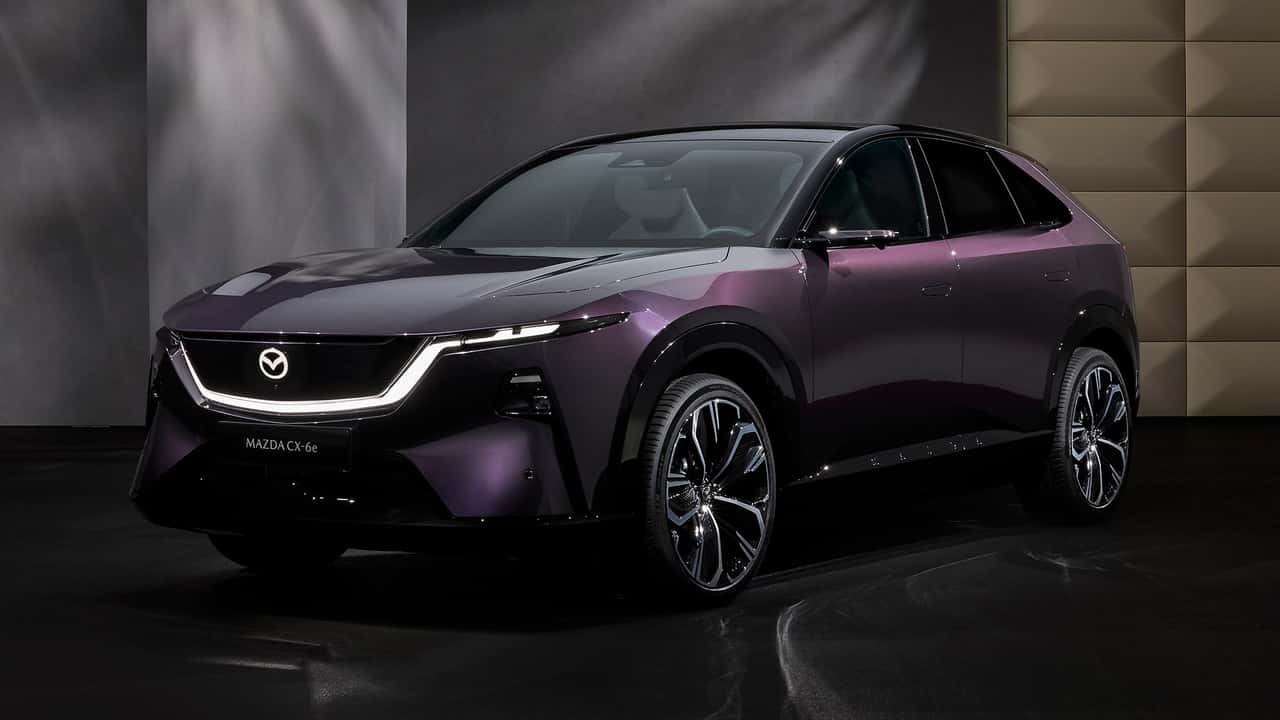
The Mazda CX-6e uses a front speaker to warn people ahead of the car, but it can also project custom text and live voice messages.
Mazda’s CX-6e is built to warn cyclists and pedestrians when its electric motor is too quiet to notice. It does that through a front-mounted speaker Mazda calls the External Announcement system, which Mazda introduced globally with the CX-6e in January 2026 as part of the SUV’s human-machine interface.
The function also lets the driver type a custom message, or broadcast their own live voice. Testers in Australia found almost nothing stopping the words from turning foul.
Mazda CX-6e
The CX-6e is a China-built electric vehicle that, as of October 2026, is sold in markets including Europe and Australia but not in the United States. Its External Announcement system was designed as a safety feature first. Drivers can trigger prerecorded, digitized-voice warnings meant to alert people crossing in front of a nearly silent electric car.
Beyond the canned warnings, the system lets a driver type a phrase on the vehicle’s 26.45-inch touchscreen and save it as a shortcut for later playback. The same speaker also doubles as a live microphone, turning the car into a rolling PA system aimed at whoever is standing in front of the bumper.
That dual function sets it apart from the backup-warning chimes already required on hybrids and electric vehicles sold in the US, which play a fixed, regulator-approved sound rather than anything the driver creates. Mazda has used other unconventional cabin choices before, including its move to ditch a control knob for a touchscreen on other models.
Reviewers testing the feature found it would read back nearly anything typed into the shortcut field, profanity included. No meaningful filter caught foul language before it reached the external speaker, and live speech through the same output carries the same lack of a guardrail.
The lack of any real filter already carries a potential cost in Australia. State road rules in places such as Queensland and New South Wales restrict how drivers use horns and other warning devices. Authorities can issue fines for offensive language used in public, but official guidance does not spell out a dedicated external-speaker misuse offence.
Western Australia also has penalties under its traffic and public-order laws. Current legislation lists a $6,000 AUD ($4,170 USD) maximum that can apply to offensive or improper use of a car’s external loudspeaker.
Mazda has not issued a public statement addressing a profanity workaround or promised a software fix to filter language on the shortcut feature. In its CX-6e launch material and product pages, the company instead describes the External Announcement system in neutral terms as part of the SUV’s safety and user-experience package.
For now, the only real check on what the CX-6e says to traffic is the driver’s own judgment.
More From Mazda:
Source:
We want your opinion!
What would you like to see on Motor1.com?
– The Motor1.com Team