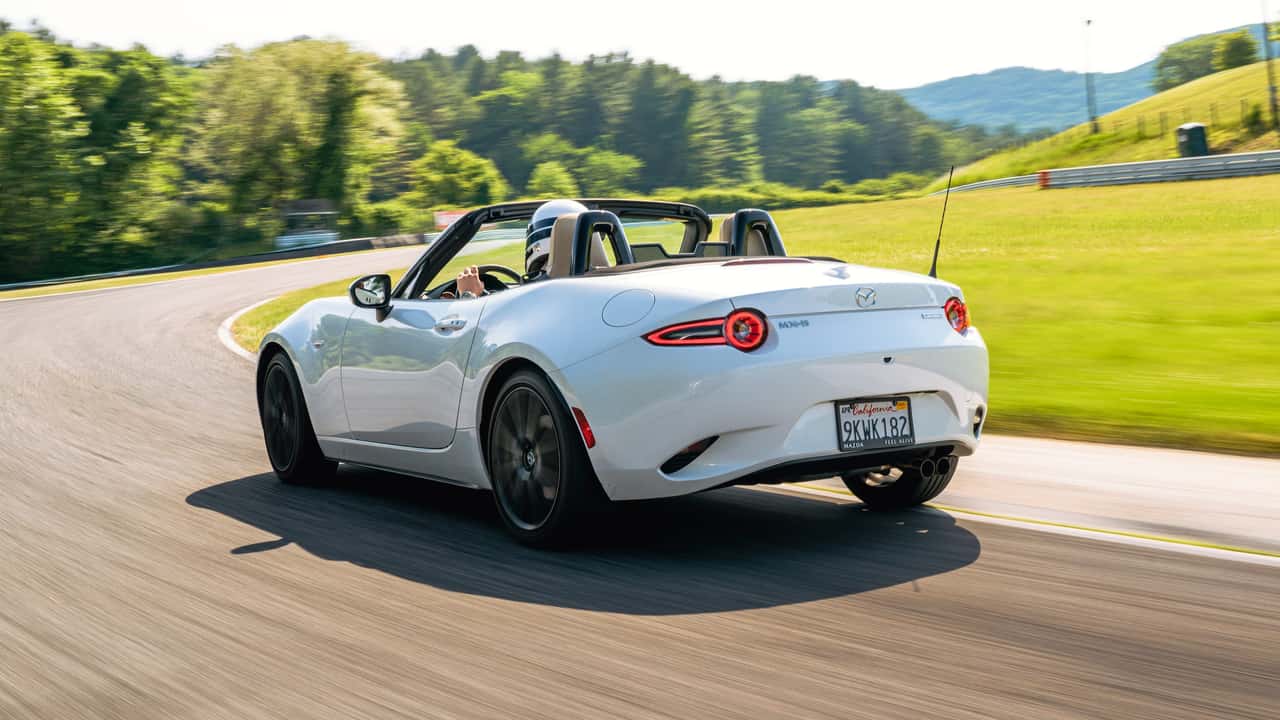
Motor1 Italy sat down with Roberto Pietrantonio, Managing Director of Mazda Italia, who spoke about the next-gen Miata’s development.
The Mazda MX-5 Miata has always been a bit of an icon—a car that’s basically synonymous with pure driving fun. A new generation is on the way, still a couple of years out, but it’s already starting to take shape, thanks in part to direct input from enthusiasts—even those in Italy.
That’s actually where I began this story, sitting down with Roberto Pietrantonio, Managing Director of Mazda Motor Italia. We talked through some of the big topics shaping Mazda right now and where it’s headed next—from the future of the roadster to the thinking behind updates like the CX-60 and CX-80, and how the Italian market fits into an increasingly complex landscape. And yes, we also touched on Ferrari and the whole “Luce” name situation.
This story originally appeared on Motor1 Italy
Roberto Pietrantonio, Managing Director of Mazda Italia: I can say that recently, a delegation of Japanese engineers visited Italy to meet with MX-5 community groups. It’s an approach that fits Mazda’s philosophy very well: listening directly to enthusiasts. We’re fortunate to have extremely engaged customer groups that provided valuable feedback to our engineers, who are already working on the future of our icon.
Absolutely. Europe, Italy, Germany, and the UK are among the most important markets for the MX-5.
Yes, depending on the setting and who we’re speaking with. The engineers gather organized information, also with support from the Italian team. The MX-5 is a global car, and the dialogue involves customers worldwide, from the United States to Australia. Still, one common element keeps coming up: the desire to preserve the car’s DNA. As I often say, even when cars can fly, the MX-5 will still put a smile on the driver’s face.
Mazda MX-5 Miata Grand Touring
Yes, Mazda puts people—and passion for cars—at the center. Interaction with customers is essential: it’s not based only on data, but also on direct, human conversation. We saw that with the CX-60: updates, including design changes, came from user feedback.
It’s the third evolution since the 2022 launch. It follows the Japanese principle of Kaizen, or “continuous improvement,” based on the experience of thousands of customers. For 2026, we focused mainly on driving dynamics, suspension, and steering to improve the balance between sportiness and comfort. Our goal is to deliver a driving experience that gets better over time, consistent with Mazda’s trademark focus on driving enjoyment. That result comes from a holistic approach that integrates design, chassis, engine, and electronics.
We also improved cabin quietness with dual-pane front glass and changes to engine-bay insulation. On the safety front—already at the highest levels—we introduced a system that, in the event of an accident, helps secure the vehicle and makes it easier for emergency responders.
Diesel is ideal for drivers who rack up a lot of miles and want efficiency without giving up performance and comfort. The plug-in hybrid, on the other hand, is perfect for those who can take advantage of electric driving on daily trips while still having an internal-combustion engine for longer journeys.
The 3.3-liter inline-six mild-hybrid diesel is compatible with HVO fuels, which can reduce CO2 emissions by up to 77 percent. The plug-in, meanwhile, is the most powerful road-going model Mazda has ever produced.
It’s part of the Takumi Nuri paint lineup, introduced with Soul Red, the color that became a symbol of Mazda design. These are finishes inspired by the Japanese artisan tradition of the “Takumi” masters, but made using advanced industrial technology.
The special triple-layer structure, with translucent and clear layers, creates depth and light effects that highlight the bodywork’s lines. The result is a dynamic effect: colors like Soul Red Crystal or Machine Grey change their appearance depending on light and surroundings, enhancing Mazda’s signature clean design and making it look different—and more expressive—every time.
European Mazda CX-80
Yes, the CX-80 follows a path parallel to the CX-60. It’s longer—nearly 16.4 feet—and it can be configured with three rows of seats, so it’s aimed at larger families or anyone with greater space needs. Here too, the updates you’ll see come from customer feedback.
Italy is a key market. The CX-30 and CX-5 are very important models, with the latter having just reached its third generation. However, we don’t expect significant growth in the overall market in 2026, partly due to the economic climate.
For Mazda, though, we expect growth thanks to new models, such as the CX-6e EV, which has already generated interest. The challenge remains EV adoption in Italy, which still trails other countries.
I have two points to make. The first concerns the link between Mazda and Italy: it’s a long-standing relationship, reflected in past models with Italian names and collaborations with designers from our country. That has helped make Mazda a unique brand among Japanese automakers, with a clearly distinctive design identity.
As for the situation, as you’ve already written, nothing happened: there was never any conflict. In fact, for a brand like Mazda—whose reason for being is passion for the automobile—Ferrari is a natural benchmark. There has always been strong mutual respect, and even in Italy, the relationship between the two brands has been positive. The matter, therefore, ended calmly, with no reason for tension.
The Future Of Mazda
We want your opinion!
What would you like to see on Motor1.com?
– The Motor1.com Team