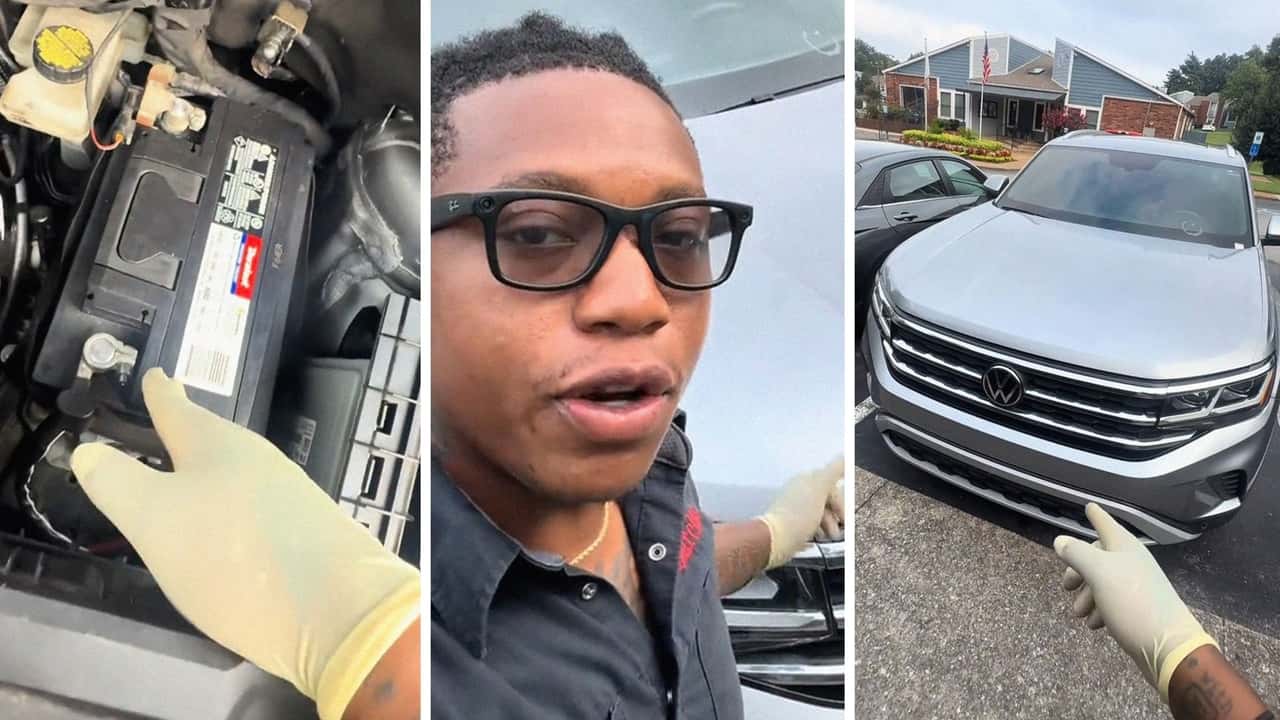
“Who replaced the battery the 1st time!!!”
A recent viral TikTok clip began as an under-the-hood mystery with many conflicting clues. The 2023 Volkswagen Atlas had a check engine light, warning messages across the dash, and a steering wheel that suddenly felt almost impossible to turn.
Mobile mechanic Reynolds Rolling Auto Repair (@reynoldrollingautorepair) started his problem-solving mission with one question: What had someone touched right before all of the red flags appeared? The answer sent Reynolds straight back under the hood.
“Check engine light. I mean, everything. So (I) try to turn the steering wheel and it is hard to turn,” mechanic Khamarckus Reynolds said in the clip that’s been viewed more than 95,000 times. “The first thing that stood out to me was she said she had the battery replaced, and after she had the battery replaced, that’s when all her issues started.”
The battery installed by the previous mechanic was an H6, but Reynolds immediately spotted a problem: the vehicle had been fitted with a conventional flooded battery.
“How can I test anything when we don’t even have the correct battery inside the vehicle?” Reynolds said.
His scan tool showed a low system-voltage reading along with several communication faults, including one involving the power-steering control unit. Rather than assuming the Atlas had suddenly experienced multiple unrelated failures, he suspected the electrical supply was the root cause for a cascade of problems.
From there, he started with the simplest correction: replace the battery with the H6 AGM unit he believed belonged in the car, and then see how much more toolbox sleuthing he would need to do.
The battery swap cleaned up much of the mess, but there were still some lingering issues he needed to solve. Among them were scanning tool warnings for the brakes, power steering, and the tire-pressure system, along with a low-voltage fault connected to the steering-angle sensor.
Reynolds focused on the fault code indicating that the steering-angle sensor had lost its calibration. His first attempt was to handle the reset electronically through his Autel scan tool.
That didn’t work. From there, he moved on to a manual reset method, which involved turning the steering wheel all the way to the left, then all the way to the right, before returning it to the straight-ahead position.
The decidedly low-tech move saved the day.
“After I manually calibrated that steering angle sensor … we got our power steering back,” he said.
Reynolds’ step-by-step process showed the importance of patience in the world of auto repairs. The incorrect battery was the first obvious problem, but simply installing the correct AGM battery didn’t suddenly clear up all of the follow-on issues.
The biggest remaining problem was a steering-angle sensor that needed recalibration after the vehicle’s electrical system was disturbed.
That stubborn-but-solvable problem was why the Atlas looked to be so much more seriously broken than it apparently was. The long list of warnings triggered when voltage drops, or when control modules lose communication or calibration, can create the appearance of several simultaneous failures.
For viewers, the burning question was all about the blame game: Who installed the first battery?
“Who replaced the battery the 1st time!!! We need to know!!!” one commenter wrote.
Reynolds didn’t have an answer.
“That I don’t know,” he replied. “She just said some mechanic.”
The need-to-know factor is likely part of the reason why the clip resonated with people who don’t know much about cars. One viewer summed it up bluntly: “Do I know anything about cars? No. Do I know what you were talking about? No. Did I watch this entire video? Yes.”
There’s a pretty straightforward reason the repair produced such a dramatic collection of symptoms. Volkswagen’s guidance for the Atlas notes that various warning lights can appear after the 12-volt battery has been disconnected and reconnected, and that some may clear after the vehicle is driven.
Battery replacement may also require an electronic adaptation procedure to ensure the vehicle’s charging and battery-management systems properly recognize the new unit. A weak or incorrect battery can contribute to low-voltage faults and communication problems, while interrupting power can also leave systems needing to relearn settings or recalibrate sensors.
The mystery bad battery install led to what looked like several unrelated failures arriving at once. Reynolds saw through the noise and conflicting messages, worked backward from the most recent repair, and then dealt with the small lingering problems that remained.
Via email, Reynolds told Motor1 that he hopes owners “stay aware of the maintenance on their vehicles.”
We want your opinion!
What would you like to see on Motor1.com?
– The Motor1.com Team