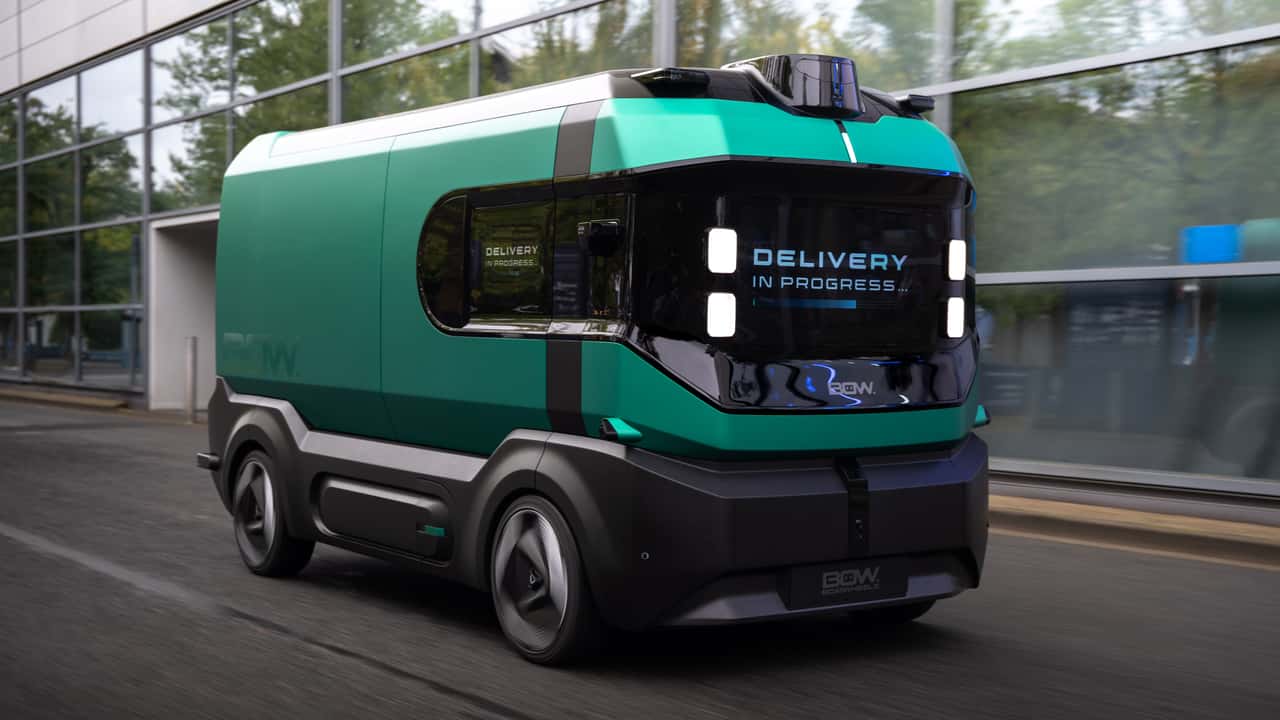
Stellantis BOW strips away the cab to create an electric autonomous cargo module aimed at controlled urban logistics zones and last-mile delivery trials.
Stellantis just showed the world a delivery van with no windshield, no dashboard, and no seat for anyone to sit in. The BOW concept, unveiled at IAA Transportation in Hannover, Germany, is a fully electric, driverless box built to move parcels through cities without a human behind the wheel.
Stellantis Pro One built BOW (Box On Wheels) with UQI Robotics, and the company is clear that it is just a concept, not a product you can order. Initial validation runs start in Europe, with no production timeline yet.
Strip away the cab, the windshield, and the dashboard, and what is left is basically a rolling cargo container with wheels and a battery. That is the entire premise, a delivery van rebuilt around the cargo, not the driver.
Stellantis says BOW “is meant to explore what autonomous logistics could look like in cities, low-emission zones, and controlled spaces like factories, hospitals, and airports.” That is a deliberately narrow set of environments that excludes open highways or mixed traffic with pedestrians darting between parked cars.
Those controlled settings matter because they are where autonomy is easiest to test safely. A factory floor or an airport tarmac is a far more forgiving test bed than a downtown street full of cyclists, double-parked trucks, and impatient drivers.
Stellantis has kept the spec sheet essentially empty and has not shared battery capacity, range, payload, motor output, sensor hardware, or any autonomy level. That silence is unusual even by concept-vehicle standards.
BOW did not appear in isolation. Stellantis Pro One used the same Hannover stage to debut Pro One NEXT, its fleet uptime operating system, alongside a new commercial van.
That timing is not a coincidence. BOW reads less like a standalone vehicle launch and more like a proof of concept for a broader ecosystem Stellantis is building around connected data, financing, insurance, and a dealer network meant to keep fleets running with minimal downtime.
UQI Robotics brings the autonomy know-how to a partnership where Stellantis supplies vehicle engineering and manufacturing scale. Pairing a legacy automaker with a robotics specialist is itself a signal that Stellantis views driverless delivery as too specialized to build entirely in-house, much like other automakers developing electric van platforms for European fleets.
Fleet operators eyeing BOW should treat this project as an early-stage concept rather than a vehicle open for purchase orders. Real-world validation in Europe will decide whether Box On Wheels moves beyond demo laps outside Hall 13 toward anything resembling regular service.
Motor1’s Take: BOW is less a van and more a rolling test case for how far fleets can push driverless delivery in tightly managed spaces. The missing specs and concept-only status mean it is years from hauling real packages on public streets. For now, it shows how seriously Stellantis takes electric last-mile logistics, even if the details stay under wraps.
More From Stellantis:
Source:
Stellantis
We want your opinion!
What would you like to see on Motor1.com?
– The Motor1.com Team