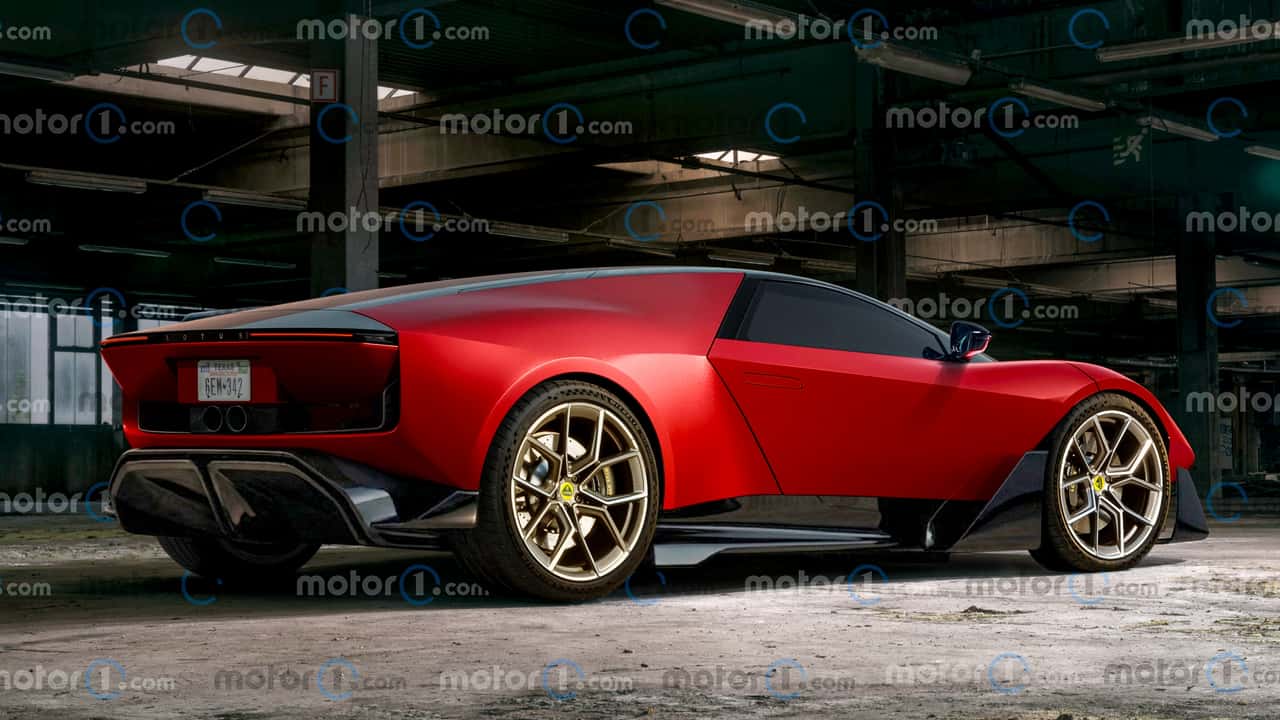
The Esprit’s engines, hybrid system, and gearbox are all being engineered with one goal in mind: keeping weight down.
Lotus has been going through a major transformation, but it hasn’t forgotten what made the brand famous in the first place. The British sports-car specialist is preparing a new mid-engined model that will combine a V6 or V8 with hybrid technology, and it’s targeting more than 1,000 horsepower without letting the car balloon in weight (too much).
Known internally as the Type 135, the upcoming sports car is scheduled to debut in 2028. Lotus hasn’t officially said it will be called Esprit, but all signs point to the iconic name returning after a 22-year absence. The last Lotus to combine those ingredients was the original V8 Esprit, which went out of production in 2004.
Speaking during a recent earnings call, CEO Qingfeng Feng described the Type 135 as a critical high-performance hybrid product for the company’s next phase. And Lotus isn’t messing around with the numbers. The V8 version will produce more than 1,000 horsepower, while the entire car is being engineered to weigh around 1.5 metric tons (3,307 pounds). That’s a seriously ambitious target considering the hardware involved: an 800-volt electrical architecture, a hybrid system, a V8 engine, and electric motors.
Lotus Esprit rendering by Motor1
Lotus openly acknowledges that keeping the weight around 1.5 tons will be one of the project’s biggest challenges. But that’s also where the company believes it can set itself apart. Lightweight engineering, aerodynamics, and chassis tuning remain central to the Type 135, with Lotus determined to prove that electrification doesn’t automatically have to turn a sports car into a heavyweight.
The company has already gone to extreme lengths to save weight. Lotus says it has used Formula 1 technology to reduce the mass of a 150-kilowatt electric motor from the typical 75-95 kilograms (165-209 pounds) to just 20 kg (44 lbs). It’s also co-developing an eight-speed dual-clutch transmission with Horse, designed to handle high torque while keeping weight to a minimum.
Like pretty much every other automaker, Lotus is embracing hybrid power for regulatory reasons. For the Type 135, Lotus says the V6/V8 hybrid approach will help it comply with global emissions regulations while retaining the characteristics traditional sports-car buyers expect. So before you bring out the pitchforks, electrification is a necessary evil, and in 2026, it’s becoming increasingly difficult not to embrace hybrids. The most recent example is Audi’s new plug-in RS5.
The company originally committed to becoming fully electric, but it has since acknowledged that the global transition to EVs isn’t happening at the same pace everywhere. Lotus has therefore switched to a multi-powertrain strategy covering combustion engines, hybrids, and pure EVs.
The powertrain itself is another major change for Lotus. The company says limited in-house powertrain capabilities have historically been one of its biggest handicaps, forcing it to rely heavily on outside suppliers. For the Type 135, Lotus is co-developing the high-performance powertrain with Horse, using Geely’s resources, supply chain, and scale while keeping Lotus focused on what it does best: lightweight construction, aerodynamics, and chassis tuning.
For now, Lotus isn’t revealing the full technical specification. The company says the Type 135 remains under development and that it will announce additional product and technical details later. But the basic recipe is already clear: a mid-mounted V6 or V8, hybrid assistance, an 800-volt electrical system, more than 1,000 hp in V8 form, and a target weight of around 1.5 tons.
Lotus Type 135 teaser
Motor1’s Take: Long story short, Lotus is trying to make sure the extra hardware doesn’t undermine the lightweight philosophy that has defined the company for more than seven decades. At the same time, hybridization is becoming increasingly difficult to avoid if automakers want to keep combustion engines alive, especially in heavily regulated regions such as Europe.
It’s getting harder to meet modern emissions regulations with large-displacement engines without some form of electrification, making hybrid V6 and V8 powertrains a natural compromise. It’s either this or nothing.
More From Lotus:
Source:
Lotus
We want your opinion!
What would you like to see on Motor1.com?
– The Motor1.com Team