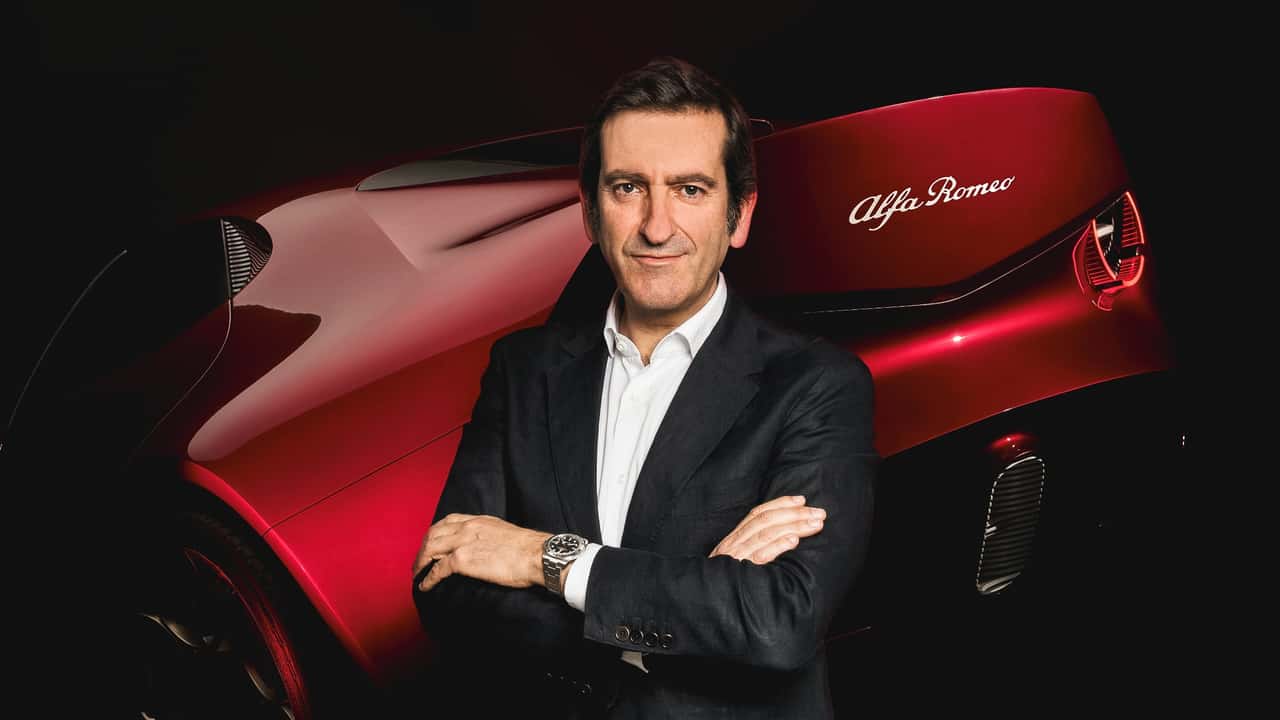
Alejandro Mesonero, head of Alfa design, discusses the Cuorerosso concept and future models.
After getting our first look at the Cuorerosso, it’s time to hear from the person who designed the concept alongside his team. Our colleagues at Motor1 Italy met with Alejandro Mesonero-Romanos at the Alfa Romeo Style Center in Turin to discuss the thinking behind the car.
It was an interesting conversation that offered insight into the design choices behind the Cuorerosso and the principles that could shape future Alfa Romeos. From its silhouette that blends coupe and sedan proportions to an interior built around the driver, the concept is a statement of intent.
It’s not a preview of specific production models, but rather a glimpse at the direction the brand wants to take. (This story originally appeared on Motor1 Italy)
When designing the Cuorerosso, Mesonero asked his team to start with a sculpture, without worrying about platforms, wheels, or windows. The priority was to get the proportions and volumes right before adding the elements needed to turn the shape into a car.
The result is a four-seat design that blends the lines of a coupe with the practicality of a sedan. Mesonero sees this approach as more sophisticated than a traditional two-seat sports car because it combines beauty with functionality.
The proportions are relatively realistic, too. The Cuorerosso measures about 185.0 inches long, 77.0 inches wide, and 51.0 inches tall. The goal wasn’t to create a futuristic car just for the sake of it, but to explore a design that could eventually translate to a production vehicle.
The Cuorerosso draws on elements of Italy’s design heritage without relying on direct references to classic cars. Mesonero sees echoes of Pininfarina’s elegance and the bold rear-end designs associated with Zagato and Bertone, all reinterpreted through a contemporary lens.
For him, Alfa Romeo’s job isn’t to recreate its greatest hits. It’s to use that heritage as inspiration for something new. One example is Marcello Gandini’s Carabo, a concept that looked firmly toward the future rather than seeking comfort in the past.
That philosophy could influence the brand’s next generation of production cars. Mesonero isn’t giving away specific details about upcoming models, but he does point to a few guiding principles: simplicity, clean surfaces, fewer lines, and a distinctive visual identity.
The cabin follows the same philosophy of visual continuity as the exterior. Mesonero describes it as an organic heart, with surfaces flowing from the dashboard toward the rear seats. The driver remains the focal point, but the cabin avoids the feeling of being boxed into an enclosed cockpit.
One of the most interesting features is the dynamic dual-binocular instrument cluster, which can combine into a single unit to display essential driving information. The center console also integrates a screen alongside physical controls, striking a balance between digital technology and traditional interaction.
That balance reflects a broader philosophy. As Mesonero sees it, adding more screens and information doesn’t automatically make a car better. It can create more distractions and drive up costs without delivering a corresponding benefit. Instead of chasing ever-larger displays, Alfa Romeo wants to integrate technology more thoughtfully.
As for the finer details, Mesonero’s favorite feature is the wheels. Their construction is complex, but the overall design remains simple, with distinctive openings that pay tribute to Alfa Romeo’s heritage. He also highlights the hood’s sensual curves and the rear end’s more aggressive character.
How much of the Cuorerosso’s design will make it into future production cars? We suspect quite a lot.
We want your opinion!
What would you like to see on Motor1.com?
– The Motor1.com Team