Spring in southern Montana transforms the Yellowstone River into a fast-moving force. Snowmelt from the mountains swells the channel into a surge of whitewater, pushing downstream toward the edge of Yellowstone National Park.
Beneath that rushing surface, Billings-based Tru Directional Drilling was tasked with installing fibre infrastructure to connect a remote retreat where reliable internet had long been out of reach. The job required two extended bores beneath the river during peak runoff, creating conditions that left little room for error.
With steep terrain, limited riverbank access, and powerful currents, the project demanded more than conventional drilling practices. Success would depend on careful preparation, dependable equipment, and an unconventional approach to locating.
To complete the work, the crew relied on Ditch Witch drilling systems, Subsite locating technology, and support from their local dealer.
The project originated with Triangle Communications in Havre, Montana, as part of a broader regional fibre upgrade. While the scope appeared straightforward on paper, field conditions quickly proved otherwise.
"Spring runoff was the biggest challenge," says Trevor Herman, president of Tru Directional Drilling. "The river was roaring and locating across it was tough."
The crew needed to complete two crossings, each spanning hundreds of feet beneath the river. With more than 500 feet separating entry and exit points, traditional walkover locating was not an option.
Tracking from a boat was considered but quickly dismissed due to the strength of the current. Holding position long enough to gather accurate data simply wasn't feasible.
Instead, the team devised a different solution.
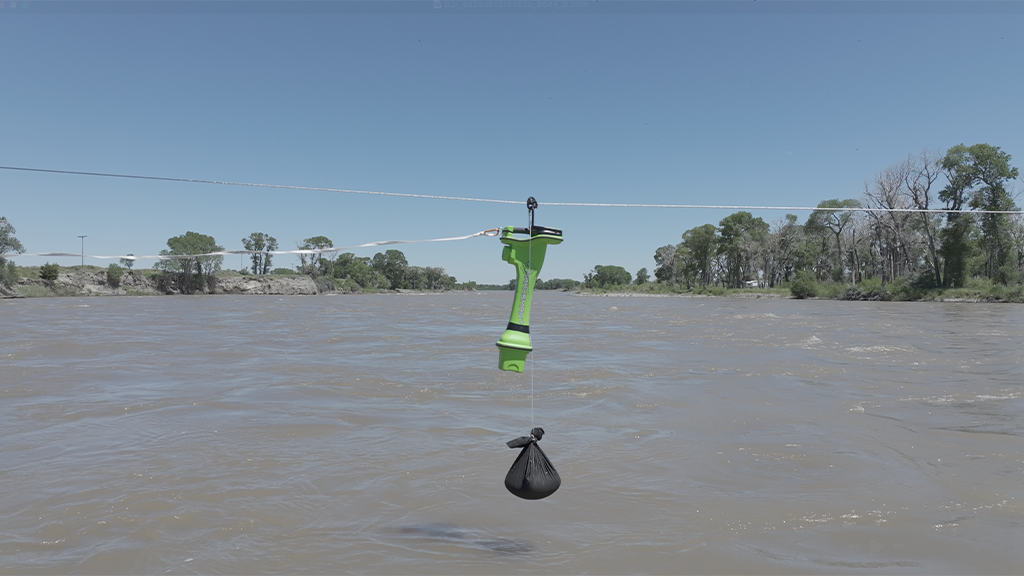
Using a pulley system anchored to a nearby bridge, they suspended a Subsite Marksman+ HDD locator roughly 60 feet above the river. From this elevated position, the locator maintained a clear signal path to the drill head moving beneath the riverbed.
Operators controlled the locator from both banks, moving it across the span to monitor pitch, signal strength, and drill head location throughout the bore.
Setting the system wasn't easy. Wind, spray, and strong currents made it difficult to secure the cable across the river, requiring multiple attempts before it was properly tensioned. Once in place, however, the setup provided the consistent locating data needed to guide the operation safely.
"Crossing more than 600 feet under a river requires a high level of confidence in both the equipment and the crew," says Brett Romer, Subsite regional sales manager. "Having the right locating technology in place makes it possible to maintain control and visibility throughout the shot."
On a project like this, success begins long before drilling starts.
High water levels, unstable banks, and rapidly changing conditions made planning critical. With limited ability to make adjustments once the bore was underway, every detail had to be addressed in advance.
"Preparation is everything on a crossing like this," Herman says. "You want to know exactly where you're starting and where you're exiting before the first rod goes in."
The crew used a Ditch Witch HX75 vacuum excavator to pothole and expose existing utilities, confirming ground conditions and reducing uncertainty before drilling began.
Dealer support also played a key role. Tru Directional's relationship with Ditch Witch West provided access to technicians, parts, and service, resources that are especially valuable on remote job sites.
"When you're running jobs in places like this, you need a partner that understands what you're dealing with," Herman says.
Reliable support, combined with thorough planning, helped ensure the operation stayed on track from start to finish.
The Yellowstone project marked the first job for Tru Directional's Ditch Witch AT120 all-terrain directional drill.
Purchased with challenging crossings in mind, the AT120 delivers the torque and steering control needed to maintain a consistent bore path in difficult ground conditions, including hard rock formations.
"This job is exactly why we added the AT120 to the fleet," Herman says. "When you're looking at a river crossing that long, you need the power and stability to keep everything moving forward."
The first bore stretched approximately 900 feet beneath the river and served as an initial test for the new machine. With support from the Ditch Witch West team on site, the crew worked through set-up and refined their process over the course of about a week.
With adjustments made, the second crossing progressed more efficiently, finishing in roughly three and a half days.
In total, both bores were completed in less than two weeks.
From the operator's seat, the AT120 provides real-time data including thrust, inner rod rotation, and drilling speed. This visibility allowed the crew to closely monitor performance and maintain steady progress throughout the crossing.
Tru Directional Drilling has built its reputation on tackling complex HDD projects across the Rocky Mountain region. Working in remote locations with a small team requires both adaptability and dependable equipment.
"You learn pretty quickly that every bore is different," Herman says. "You can plan everything perfectly, but once you start drilling, the ground always has something new to say."
Over time, the company transitioned its fleet to Ditch Witch equipment, citing advantages in both drilling performance and dealer support. Today, the lineup includes the AT120, AT32, and AT40 drills, along with the HX75 vacuum excavator.
"When you're taking on bigger jobs with a small team, downtime is not an option," Herman says. "You need equipment you can trust."
Completing two long crossings under the Yellowstone River represented a significant achievement for the crew.
The project integrated planning, equipment, technology, and expertise to perform under demanding conditions.
"When you're standing on the bank looking at a river like that, you know it's going to be a challenge," Herman says. "But when everything comes together, that's one of the best feelings you can have on a job."
With the strength of the AT120 and the precision of the Marksman+ locator, the crew successfully installed fibre beneath one of the region's most powerful waterways.
Above, the Yellowstone continues its relentless flow. Below, the newly installed infrastructure runs quietly through the riverbed.
As fibre expansion pushes into more remote and rugged areas, projects like this demonstrate how modern drilling and locating technologies are enabling contractors to take on increasingly complex crossings — work that would have been far more difficult just a decade ago.
1950 W. Fir Ave
Perry, OK
US, 73077
Website:
subsite.com
1959 W. Fir Ave.
P.O. Box 66
Perry, OK
US, 73077-0066
Website:
ditchwitch.com