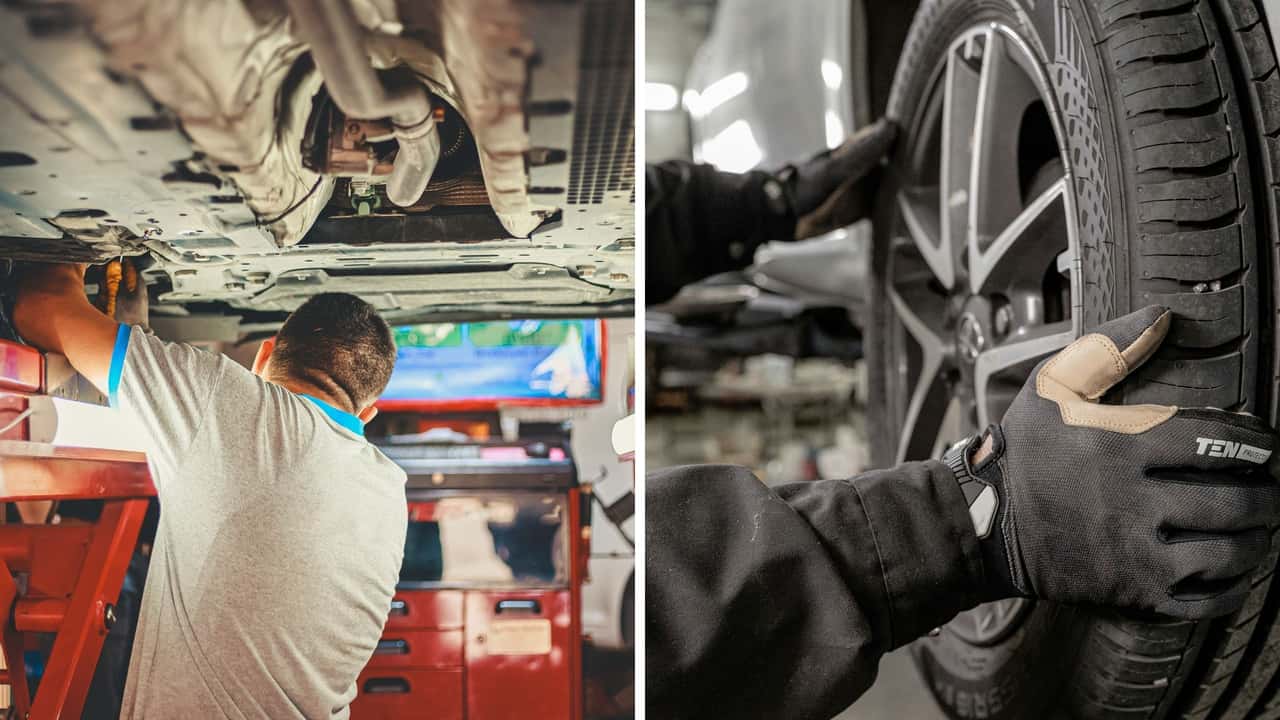
‘Um, this tire…’
At first glance, the tire seems fairly ordinary and suitable for the road. It looks used and maybe a little worn, but otherwise sturdy and serviceable.
But in a viral Facebook Reel, we learn that the four-digit number stamped on the sidewall serves as a timestamp that tells us this tire is old enough to legally drink.
“This tire… is from 2003,” remarks the incredulous narrator in the video, which was posted by the auto enthusiast account Just Rolled In and has received more than 1,400 likes.
The clip doesn’t show the full exchange between the driver and the shop, just the close-up of the well-aged tire.
According to the narrator, the vehicle’s owner declined the recommendation for new tires, saying he “has a guy.” Instead of arguing the point, the camera simply moves in closer and lets the sidewall tell the story.
It’s a quiet but definitive rebuttal, with no raised voices or back-and-forth. And the four digits imprinted on the tire present the situation in an unshakable way.
That subtle reveal is exactly what set off a debate in the comments section, where reactions ranged from jokes to outright dismissal.
“Is [t]his guy’s name Methuselah?” one viewer joked.
Others weren’t convinced that age alone is a problem. “If the tread is still good, it’s fine,” another commenter argued, echoing a common belief that visible wear is the only thing that matters.
Some took the opposite stance, pointing out that tires age out regardless of how they look. “Replace after seven years,” one commenter offered.
There were also some outliers: drivers who claimed to have run decades-old tires on farm trucks or personal vehicles without issue. The result is a familiar split between personal experience and anecdotes on one side and manufacturer guidance on the other.
The four-digit code shown in the video isn’t obscure or a secret. It’s part of the tire’s Department of Transportation identification number. In the case of the tire shown on the video, the numbers “1403” indicate that the tire was manufactured in the 14th week of 2003.
That puts it far beyond what most manufacturers consider safe. While tread depth is easy to gauge, age-related degradation isn’t. Over time, the rubber hardens, and the internal structure can weaken, even if the surface still appears usable.
That’s why tire makers recommend replacement somewhere in the six- to 10-year range, regardless of mileage.
Part of the confusion comes down to what drivers can and can’t see. Worn tread is obvious, as are cracking sidewalls. But the general effects of age are harder to detect, and without visible damage, it’s easy to assume that a tire is still roadworthy, especially if it’s holding air and performing without issue.
Adding in the cost of replacement and skepticism toward repair recommendations is easy to understand. It also helps explain why moments like this resonate so widely online.
The video doesn’t rely on a dramatic failure or a roadside breakdown. There’s no blown tire or warning light and no immediate consequence, just a number that quietly points toward a kind of clock-ticking risk.
For drivers watching the clip, the takeaway isn’t complicated, but it’s easy to overlook. That four-digit code is on every tire, and it’s one of the quickest ways to understand what you’re actually driving on.
It’s an easy thing to check in just a few seconds. Look for the DOT number on the sidewall and find the last four digits. They’ll tell you the week and the year the tire was made, which is more definitive than deciding based on how the tire feels on the road or measuring how much tread is left.
From there, the decision isn’t necessarily automatic since tires don’t expire overnight. Not every older tire is automatically on the verge of failure, but once you know the age, you’re making any replacement decision with better information instead of guesswork.
If replacement is on the table, there are ways to keep the cost manageable. Shopping from budget brands, looking at recently used options from reputable shops, or even replacing just the most worn pair can buy time without putting off the issue entirely.
Motor1 reached out to the creator via direct message and commented on the clip. We’ll update this if they respond.
We want your opinion!
What would you like to see on Motor1.com?
– The Motor1.com Team